Guidelines - The Principles in Practice
US organisation CAST, which first developed the UDL Framework, have produced a set of key guidelines related to each of the core principles of UDL.
The goal of UDL is learner agency that is purposeful & reflective, resourceful & authentic, strategic & action-oriented.
CAST's UDL Guidelines
Principle: Design Multiple Means of Representation
Guideline 1: Design options for perception
- Support opportunities to customize the display of information (1.1)
- Support multiple ways to perceive information (1.2)
- Represent a diversity of perspectives and identities in authentic ways (1.3)
Guideline 2: Design options for language & symbols
- Clarify vocabulary, symbols, and language structures (2.1)
- Support decoding of text, mathematical notation, and symbols (2.2)
- Cultivate understanding and respect across languages and dialects (2.3)
- Address biases in the use of language and symbols (2.4)
- Illustrate through multiple media (2.5)
Guideline 3: Design options for building knowledge
- Connect prior knowledge to new learning (3.1)
- Highlight and explore patterns, critical features, big ideas, and relationships (3.2)
- Cultivate multiple ways of knowing and making meaning (3.3)
- Maximize transfer and generalization (3.4)

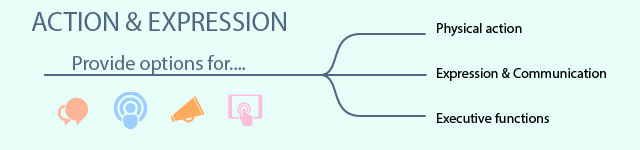
Principle: Design Multiple Means of Action & Expression
Guideline 4: Design options for interaction
- Vary and honor the methods for response, navigation, and movement (4.1)
- Optimize access to accessible materials and assistive and accessible technologies and tools (4.2)
Guideline 5: Design options for expression and communication
- Use multiple media for communication (5.1)
- Use multiple tools for construction, composition, and creativity (5.2)
- Build fluencies with graduated support for practice and performance (5.3)
- Address biases related to modes of expression and communication (5.4)
Guideline 6: Design options for strategy development
- Set meaningful goals (6.1)
- Anticipate and plan for challenges (6.2)
- Organize information and resources (6.3)
- Enhance capacity for monitoring progress (6.4)
- Challenge exclusionary practices (6.5)
Principle: Design Multiple Means of Engagement
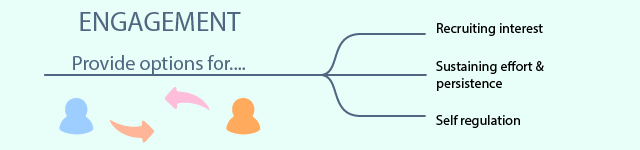
Guideline 7: Design options for welcoming interests & identities
- Optimize choice and autonomy (7.1)
- Optimize relevance, value, and authenticity (7.2)
- Nurture joy and play (7.3)
- Address biases, threats, and distractions (7.4)
Guideline 8: Design options for sustaining effort & persistence
- Clarify the meaning and purpose of goals (8.1)
- Optimize challenge and support (8.2)
- Foster collaboration, interdependence, and collective learning (8.3)
- Foster belonging and community (8.4)
- Offer action-oriented feedback (8.5)
Guideline 9: Design options for emotional capacity
- Recognize expectations, beliefs, and motivations (9.1)
- Develop awareness of self and others (9.2)
- Promote individual and collective reflection (9.3)
- Cultivate empathy and restorative practices (9.4)