Do we practice what we preach?
The Learning, Teaching and Assessment (LTA) team at Technological University Dublin collaborates with faculties, discipline teams, and academic staff to improve teaching, learning, and assessment at the University. The team offers various academic development supports, including events, face-to-face and online workshops, consultations with staff, and postgraduate taught modules and programmes, including a Universal Design for Learning (UDL) accredited module. Five LTA academic developers support staff across the University’s five faculties.
Two LTA academic developers, Edel Gallagher and Dolores McManus reflect on their experience of recent webinar delivery, with a particular focus on how the webinar design aligned with UDL principles.
Webinar design and delivery aligned with UDL principles
We had different levels of previous experience with UDL and committed to evaluating our webinar design through reflective professional conversations. The aim of these conversations was to improve future webinar delivery and to support each other to adopt a UDL attitude for enhanced individual and team practices. We wished to engage in a dynamic, iterative process, using the UDL guidelines as a starting point.
UDL is iterative, never standing still, being reflective and proactive, and all with the goal of increasing the potential of each learner to access their learning, and demonstrate their learning and demonstrate their knowledge and understanding. To do this, we have to continuously challenge ourselves and our view of inclusion. (Quirke et. al, 2023, p. 86)
We engaged in a dialogic process, which we outline here, highlighting the key themes that emerged from our reflections and an overview of the guidelines developed through the project. This work may be of interest to anyone wishing to evaluate and design professional development or teaching and learning through the lens of UDL.
The Learning, Teaching and Assessment Webinars
In May 2025, the LTA team launched a series of webinars available to TU Dublin staff which focused on a range of teaching and learning related topics including:
- Active Learning Strategies
- Effective Questioning
- Group work
The purpose of these optional webinars was to support staff, in particular lecturing staff, to prepare for the 2025-26 academic year ahead. The webinars were designed by the team of LTA Academic Developers with individual or pairs of team members responsible for specific sessions. A few consistent design decisions were made across the series. All webinars were hosted on Microsoft Teams, and Microsoft PowerPoint slides were used to present information. In all cases, presenter cameras and microphones were enabled, and participants had the choice to enable cameras or microphones and were able to contribute via the chat function.
Towards the end of the academic year, as we reflected on the webinar series, we began to consider how effectively we were modelling Universal Design for Learning (UDL) principles in our practice. As a team committed to fostering inclusive, student centred pedagogy, it felt important to pause and review the extent to which our own processes aligned with these values. In the fast pace of organising and promoting the series, there may have been opportunities to strengthen the accessibility and inclusivity of the experience for participants. Rather than viewing this as a shortcoming, we saw it as a valuable learning opportunity - one that could help us better understand our current position in relation to UDL adoption and inform the development of guidelines to support future webinar design and delivery.
Designing a small-scale project
As academic developers, we promote reflective practice as an approach to support teaching and learning enhancement. Bolton and Dederfeld (2018) state that reflective practice makes maps and can provide methods for practitioners to learn from mistakes, muddles or uncertainties. We therefore decided to engage in a reflective dialogue process focussed on reviewing our webinar provision through the lens of UDL. We set out to design a small-scale project that could be completed over a two-month period during the Summer, when we had more time and space to engage in meaningful conversations. To maintain a manageable workload, we decided to focus on one webinar in particular, rather than the full series. The original webinar had not been recorded, so we used its PowerPoint slides as a basis, along with a copy of the webinar’s chat interactions and analytics. The process is outlined in Figure 1 (below).
Inquiry process
We designed an inquiry process at the beginning of the project that had three stages:
- Dialogue meetings (Stage 1)
- Analysis of meeting outputs (Stage 2)
- Development of guidelines for future work (Stage 3).
Stage 1: Dialogue Meetings
Five one-hour meetings were hosted online on Microsoft Teams.
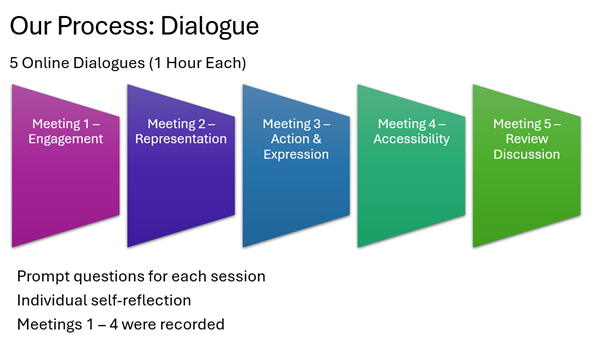
Figure 1: Meeting themes
At the beginning of each meeting, we spent a few moments individually reflecting upon the session’s theme using the relevant prompts. The themes of the meetings were underpinned by UDL’s three principles - Engagement, Representation and Action and Expression - and we felt that a session dedicated to Accessibility was merited. The aim of the final session was to draw together thoughts and recommendations that could be useful to the rest of the LTA team and external stakeholders. The initial four sessions were recorded, with their transcripts used for later analysis. We decided to leave the fifth session unrecorded to allow for full and honest discussion; however, we took notes and started to work on a guidelines document as an output of the project.
We were mindful of keeping the project to a suitable scale, so focused on one particular webinar that had been co-facilitated by us both, a webinar focused on Active Learning Strategies that took place on 28 May 2025. At the start of each dialogue session, we allowed 15 minutes for individual self-reflection around the session’s particular theme and reconvened for the remaining 45 minutes, reviewing the original webinar through a conversation based on UDL themed prompts.
Use of Generative AI
Initially, we had much discussion around the ethical and appropriate use of Generative AI tools. We decided to use an AI-powered assistant, Microsoft Copilot, for two aspects of the work:
- Support with creating discussion starters for our meetings.
- Support with analysing transcripts generated from our discussion.
Microsoft Copilot was selected, as it sits within our organisation’s software ecosystem. We had enough UDL knowledge and experience to develop the prompts ourselves, however, the use of Copilot saved us time, meaning we could move to the meaningful dialogue stage of the project.
Discussion starters
We asked Microsoft Copilot to create discussion starters for our meetings, based on the planned UDL-related themes. The full set of discussion starters that formed the basis and structure of our meetings are included in Appendix A. The use of Copilot for thematic analysis will be discussed in the next section.
Stage 2: Analysis of Meeting Outputs
While we were forming individual ideas as we progressed throughout the project, we waited until the fifth meeting to start analysis. We adopted the process outlined in Figure 2 to begin analysis of our discussions. As the meetings had been themed according to the three UDL principles with the last meeting focused on accessibility, there was already a natural theming occurring, however there was still a need to review and organise the ideas that had emerged from the meetings.
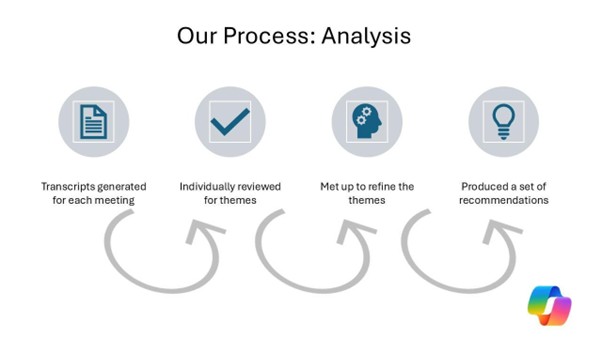
Figure 2: Overall Process for our Analysis
As we had recorded meetings one to four, we used the generated transcripts as a base for text analysis. We divided the meeting transcripts between us (two meeting transcripts each), individually reviewing and coming back together to discuss. We jokingly referred to this as our whiskey producing process, as like Irish Whiskey, our data was triple-distilled, we distilled or refined the transcript text into themes, discussed these, and further distilled these themes into a set of recommendations.
Generative AI to support thematic analysis
We asked Copilot to support with thematic analysis of each recorded meeting transcript using this prompt (adapted for each UDL principle):
Can you run some thematic analysis on this text and list the key themes emerging? The text is a discussion between two academic developers about how to apply the UDL principles of [insert principle – engagement, representation or action and expression] to a 90 minute workshop for university lecturers on Active Learning Strategies.
The main reason for having the discussion was to pull out key UDL considerations which might apply to all 90 minute webinars.
We used the Copilot-generated themes in tandem with our own, as we felt that what was generated was useful, but not context-specific enough for our purposes. The thematic codes that we developed ourselves were:
Stages of Webinar
Used where a transcript comment related to design work pre-webinar or within the webinar itself
- Design Pre webinar (Pre)
- In webinar (In)
Guidance Types
Used where a transcript comment related to technical aspects of the webinar, or more relational
- Technical (Tech)
- Relational (Rel)
Specifics
Used to differentiate where a transcript comment related to the specific Active Learning Strategy webinar only, or all webinars delivered by our LTA team
- Active Learning Strategies webinar only (ALS)
- Learning, Teaching & Assessment Webinars (LTA)
Bigger/Long term implications (Big)
Used where a transcript comment related to bigger issues beyond the scope of webinar design
- Bigger/longer term implication (Big)
SWOT
- Used where a transcript comment related to strengths (S), weaknesses(W), opportunities (O) or threats(T) to this type of work
Necessity
- Used to indicate if comments related to an issue/action that was deemed essential (E) or optional - a nice to have (NTH).
While we had originally assigned one hour to discuss the themes that emerged, this process took longer than expected, and we scheduled two subsequent meetings to develop the guidelines.
Stage 3: Moving from themes to recommendations
The production of an output, a set of recommendations for use by our team, was the most difficult aspect of the project; however, the dialogue that we had throughout this stage has solidified ideas and has kept UDL front and centre in our minds. We took our draft guidelines (below), and reviewed them further to produce a set of guidelines, ideally succinct enough for other members of our team to adopt.
| Excerpt of Draft Guidelines (ref: Active Learning Strategy webinar) |
|---|
| - Registration forms could gather more context (e.g., faculty, purpose). (ΝΤΗ) - Group activities early on could foster inclusion and belonging. (NTH) - Building time for reflection into the session is essential. (E) - Design activities that allow personal relevance (e.g., applying strategies to their own module/disciplines). (E) - Need for clearer goals and check-ins to support persistence. Scaffolding strategies and goal setting. (E) - Facilitator dialogue (two voices) improves engagement. - Playful learning and breakout rooms support informal collaboration. (E) - Minute paper or similar. - Importance of plain language, glossaries, and vocabulary. Academic language may be challenging for non-native English speakers. (E) - Reduce content to allow more time for interaction. (E) - Value of co-facilitation for pacing and reflection. (E) - Facilitate live captioning, consideration of PowerPoint's built-in captions or Teams transcription. - Improve diversity of imagery and Western-centric resources. (E) - Ensure Captions are available for Video content. Importance of user control over captions to manage cognitive load. (E) |
The overarching guidelines reached are:
Learning, Teaching and Assessment workshops, webinars, events and programmes will strive to:
- Provide an inclusive and welcoming environment that embraces diversity.
- Promote discursive, participative and engaged learning in a flexible manner that supports student choice and agency.
- Demonstrate consideration of multiple modes of representation of content, and facilitate diverse modes of expression by participants.
- Ensure clarity of language and clear structure in lesson planning, instructional design.
- Demonstrate consideration of accessibility and universal design for learning principles.
- The detailed guidelines with suggested actions are available by emailing LTA@tudublin.ie.
During this process, we discussed very useful and relevant existing guidelines, including the CAST UDL Guidelines (2024) and institutional documents about accessibility. However, we determined that there was a need for us to contextualise this information for our own practice. We relied on and will continue to use these external resources to develop our UDL practice. This project brought our attention to, and reminded us of, supports we can use in future work.
Development of a mini version of the process
While we found the overall project very beneficial to our own practice, we did recognise that we had committed substantial time, which may not be possible for everyone during a busy semester. We therefore developed a mini version of the process, underpinned by the same process and philosophy of the project, but on a smaller scale. The process involves committing to a short UDL themed reflective conversation to support evaluation of teaching experiences, including webinars. We are committed to continue to apply this mini-version of the process, and to share it with colleagues.
Mini-version: 15 minute reflection
- Decide on area for discussion: use UDL Guidelines or one question from our Discussion Starter sheet
- Use prompts to discuss
- Note actions.
From our experience, we plan to record these 15 minute conversations using Microsoft Teams so that a transcript is produced, but this is optional, the dialogue is the important part of the process.
Final Reflections
This project highlighted the impact that this set of reflective conversations had, both on our work and on our mindsets, and confidence in individually and collaboratively implementing UDL:
Maybe reflective practices offer us a way of trying to make sense of the uncertainty in our workplaces and the courage to work competently and ethically at the edge of order and chaos...(Ghaye, 2000, p.7)
A key aspect was creating a safe space for open discussion about our current application of UDL and accessibility guidelines, and to realise that we are not perfect; by continuing to have these open discussions and to commit to evaluate our efforts, we aim to continue to improve and have the courage to practice what we preach.
Appendix A
Prompt questions
Meeting 1: UDL Principle 1 – Engagement*
Goal: Stimulate interest and motivation for learning.
How does the webinar design offer choice and autonomy to participants?
In what ways are we fostering collaboration and community?
Are there strategies to sustain effort and persistence (e.g., clear goals, feedback)?
What could we do differently to better engage diverse participants?
Meeting 2: UDL Principle 2 – Representation*
Goal: Present information in multiple ways.
How are we presenting content in varied formats (e.g., visuals, audio, text)?
Are we considering language clarity and accessibility (e.g., plain language, captions)?
What supports are in place for participants with different sensory or cognitive needs?
What improvements could enhance representation?
Meeting 3: UDL Principle 3 – Action and Expression*
Goal: Provide options for participants to demonstrate learning.
How do we allow participants to interact or respond in different ways?
Are there opportunities for reflection, discussion, or application?
How do we support executive functioning (e.g., scaffolding, checklists)?
What could we add or change to support more inclusive expression?
*These prompts were created using Microsoft Copilot
Meeting 4: Accessibility
What do we do to ensure that our webinars are accessible?
Disclosure of Generative AI Use
As outlined in the article, the authors used Microsoft Copilot AI Assistant for two purposes:
Support with creating UDL-themed discussion starters for project meetings.
Support with analysing transcripts automatically generated from recorded Microsoft Team meetings.
References
Bolton, G., & Delderfield, R. (2018). Reflective practice: Writing and professional development (Fifth edition). SAGE.
CAST (2024). CAST Universal Design for Learning Guidelines version 3.0. Retrieved from https://udlguidelines.cast.org
Ghaye, T. (2000). Into the reflective mode: bridging the stagnant moat. Reflective Practice, 1(1) 5-9.
Quirke, M., Mc Guckin, C., & McCarthy, P. (2023). Adopting a UDL Attitude within Academia: Understanding and practicing inclusion across higher education. Routledge. https://doi.org/10.4324/9781003137672


