INHEF Special Feature
Fostering Positive Student Experiences in Co-Learning Environments: An educational staff officers framework for relational and academic support
Recent calls for more equitable access to third level education for students with intellectual disabilities have played a pivotal role in transforming the roles and responsibilities of universities, particularly in relation to their social responsibility (Jónasson, 2008; Lynam et al, 2025; De Souza et al, 2023). Under the Programme for Access to Higher Education model (PATH 4) phase 2, funding has been assigned to ensure students receive wrap-around support from university programmes and their support teams.
The Certificate in Applied Learning and Skills Development pilot programme in the Technological University of the Shannon is funded under PATH 4 and ensures students are supported by a team consisting of programme coordinators, lecturers, educational staff officers and a occupational therapist. The programme commenced in March 2025 and two semesters have been completed with two remaining. Semester three will see students enter co-learning classrooms followed by their final semester on work placement. This article will specifically focus on a new and innovative framework developed by an educational staff officer to support all educational staff officers as they prepare students for entering co-learning Classrooms.
For the first two semesters of the programme students with intellectual disabilities are taught in a base classroom with less than twelve students, one lecturer and two educational support officers. In semester three, students merge into co-learning mainstream classrooms with new lecturers and often over one hundred students in lecture theatres. Educational Staff Officers (ESO’s) play an integral role in ensuring the success of this transition. Situated in the classroom, ESOs have been critical in achieving positive student outcomes to date. Ideally placed they provide assistance as required, ensure access to knowledge and information using the Universal Design for Learning Principles. Outside of in-class support, the ESO’s role includes research, capturing student learnings using participation/engagement, assessments and observations, devising individual student learning plans, providing relational support, liaising with staff in similar roles across campuses.
Joining co-learning classrooms may be a source of anxiety and stress for some students. Although students on this programme have already experienced a co- learning university environment during their first 2 semesters, the co-learning classroom may present unique challenges. Interacting face to face with other students, meeting new staff and knowing what to say if asked a question can appear daunting for many. As students prepare to enter such environments the ESO’s strive to relieve any anxieties using insights gained from working with the students to date and providing a wrap-around support model. The graphic below proposes a four stage model of support for students during their co-learning experience.
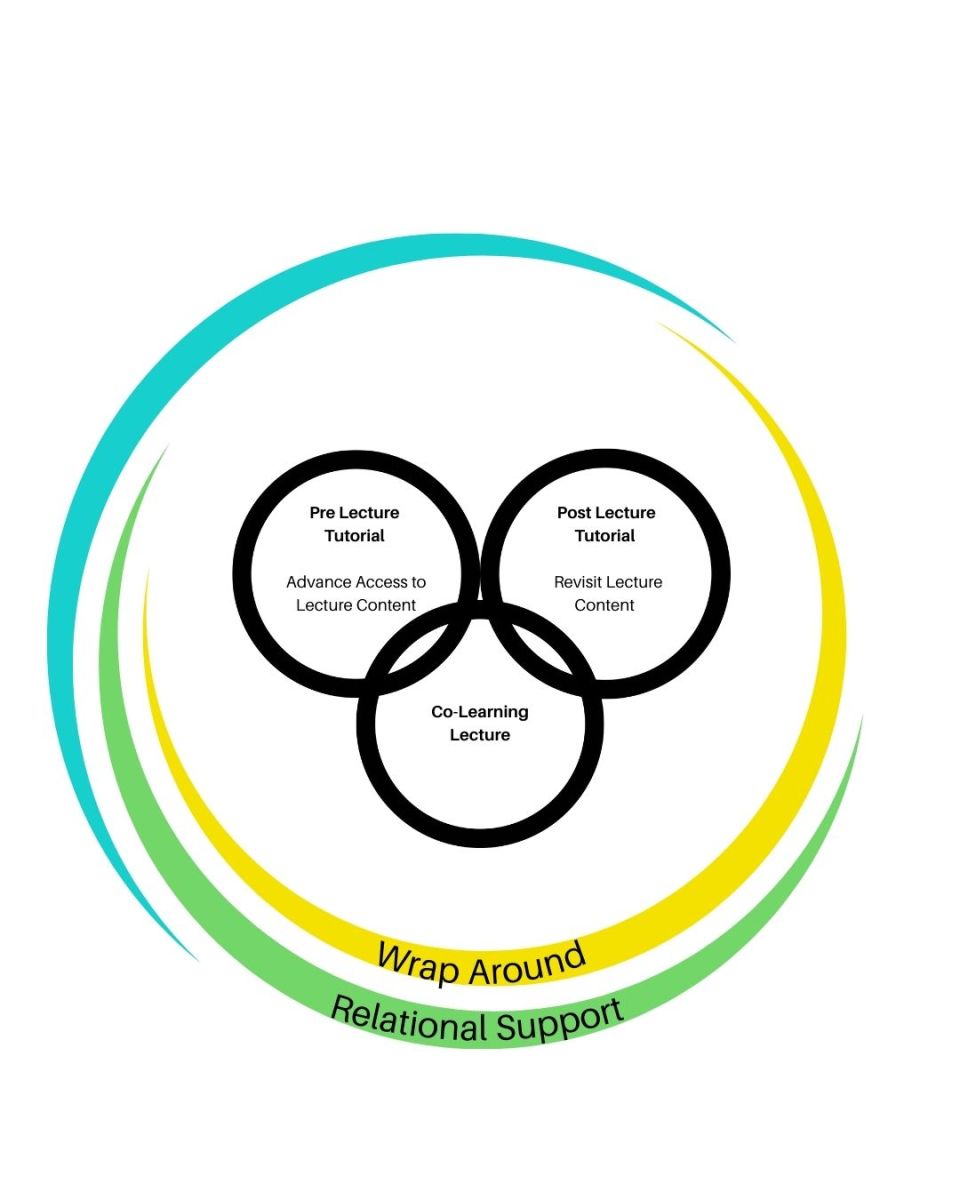
Figure 1. Four stage support model
The initial stage, the pre-tutorial or preparation phase provides students with early access to lecture material in accessible formats, facilitates engagement with course content before the lecture takes place, disseminates information in bite size pieces to enhance understanding. In a scoping review conducted by Hennessy et al (2024) which examined how people with intellectual disability experience third level education, several factors that influence student experiences were identified. These factors speak to the four stages of the proposed framework. Factors included: providing a sense of safety for students, ensuring adequate educational support structures are in place particularly focusing on student life along with tutoring/mentoring support. Equally essential were the roles of mentors and staff particularly those that operate an open door policy (Hennessy et al, 2024; Spassiani et al. 2017; Zhang, Grenwelge, and Petcu 2018). Furthermore, the students ability to trust staff was seen to have a positive influence on student experience (Hennessy et al, 2024).
The second stage ensures that students are supported during the main co-learning lecture. The level of support required may vary from student to student, but may take the form of note taking, recording lecture content, providing social and relational support and liaising with lecturers.
Stage three guarantees that all students receive a post lecture tutorial class. Informed by the Universal Design for Learning (UDL) framework, the ESO’s use creative ways to foster student engagement by providing new and innovative ways to practice and communicate learnings from the main lecture (CAST, 2018). Revisiting lecture material creates an opportunity for students to condense and digest the information in fun and manageable ways. For example, if a class lecture focuses on theories underpinning outdoor learning, then the post lecture tutorial would break this down into easier to understand nuggets of information, whilst at the same time using quizzes and fun ways of engaging.
The fourth and final stage is perhaps the most important as it provides wrap-around relational support for students. Bronfenbrenner's ecological model of human development was used to inform the framework, highlighting the significance of relationships and the impact of a person’s surroundings (Bronfenbrenner and Morris, 2006). Weekly one-to-one conversations or check-ins with students have proven vital to date in terms of nurturing rapport on the programme. Students discuss their progress or concerns, aspirations, highs and lows from the week or any topic they wish to discuss. Additionally, discussing the students’ individual learning needs and goals with the students themselves at the beginning of the programme has allowed the ESO’s to preempt student needs and provide a personalised support plan that informs the weekly check ins (Berg et al, 2017). Anxieties, self doubt and fear, especially when entering new co-learning classes may potentially have a negative impact on student experience (Hennessy et al. 2024). For this reason, continuing to provide this safe relational space for students is of the utmost importance. Conceptionalised as an outer circle in the illustration, it signifies its encompassing importance underpinning the other 3 stages.
In conclusion, using this relational, holistic and educational framework co-learning experiences could become the platform that helps students with intellectual disabilities to flourish. With the foundational seeds of personal growth being planted in the first two semesters, this third co-learning semester will help students blossom into adaptable, thriving and resilient individuals.
References
Berg, L. A., T. Jirikowic, K., Haerling, and MacDonald, G. (2017). Navigating the Hidden Curriculum of Higher Education for Postsecondary Students with Intellectual Disabilities. The American Journal of Occupational Therapy 71, no. 3. Available at: https:// doi.org/10.5014/ajot.2017.024703 (Accessed: 01 January 2026).
Bronfenbrenner U. and Morris P. A. (2006). The bio-ecological model of human development. In Damon W., Lerner R. M. (Eds.), Handbook of child psychology: Theoretical models of human development. pp. 793–828. John Wiley & Sons.
CAST (2018). Universal Design for Learning Guidelines version 2.2. Available at: http://udlguidelines.cast.org (Accessed: 23 December 2025).
De Souza, D., Pablo, Z., Shevlin, M., Von Fürstenberg, M. T., Banks, J., Sarker, D., Urzua, A. R., Camedda, D., Aston, D. (2023). Preconditions influencing the development of post-secondary training programs in universities for individuals with intellectual disabilities, Journal of Intellectual & Developmental Disability, 48, (3). Available at: https://www.tandfonline.com/doi/full/10.3109/13668250.2023.2260584 (Accessed: 06 January 2026).
Jonasson, J.T. (2008). Tomorrow's University: Who is to Take the Lead? Observatory for Fundamental University Values and Rights. Bolonia: Bolonia University Press.
Lynam, A. M., McGuckin, C., Banks, J. M., Devitt, M., Shevlin, M., Aston, D., Ringwood, B., Murphy, E., Feehan, S., Barden, O., Rath, V., Kubiak, J., Mazzocco, A., & Woodnutt, J. (2025). Creating Inclusive University Experiences: A Bio-Ecological Perspective. In C. Rogers-Shaw, T. Williams Park, K. Mohney, & K. Sheward (Eds.), Fostering a Community of Success for Neurodivergent Collegiate Students (pp. 151-186). IGI Global Scientific. Available at: Publishing. https://doi.org/10.4018/979-8-3693-8920-1.ch005 (Accessed: 05 January 2026).
Spassiani, N. A., Murchadha, N. Ó., Clince, M., Biddulph, K., Conradie, P., Costello, F., Cox, L., Daly, E., Daly, O., Middleton, C., McCabe, K., Philips, M., Soraghan, S. and Tully, K. (2017). Likes, Dislikes, Supports and Barriers: The Experience of Students With Disabilities in University in Ireland. Disability & Society 32, no. 6: 892–912. Available at: https://doi.org/10.1080/09687599.2017.1320272 (Accessed: 12 December 2025).


