WAM Celebrating 20 Years
In 2025, AHEAD marked two major milestones: 20 years of delivering the Willing Able Mentoring (WAM) programme and the launch of the Widening Inclusion of Disability in Employment (WIDE) Framework.
To honour these achievements, the AHEAD team hosted a prestigious event on 17th October 2025 at the Convention Centre Dublin, welcoming disabled people, employers, Disabled Persons Organisations (DPOs), Non Governmental Organisations (NGOs), government departments, and a broad range of stakeholders committed to advancing equality in the workplace.
The event brought attention to the ongoing work required to close the disability employment gap in Ireland. It explored the real-world challenges experienced by disabled people and employers, showcased impactful examples of inclusive practice, and opened a wider conversation about the path forward for disability-inclusive employment. This article offers a snapshot of the key moments and messages from the day.
Event Opening
The event opened with remarks from Deirdre Moore, Employment Manager, AHEAD, followed by addresses from Dr Aideen Hartney, Director, National Disability Authority and Dearbháil Nic Giolla Mhicíl, Principal Officer, Department of Social Protection. Their messages underscored both the achievements of the past 20 years and the continued work needed to reduce Ireland’s disability employment gap, which sits at the fourth lowest in Europe, with approximately 32% (percent) of people with disabilities in employment compared to 71% (percent) of the general population.
WAM Through the Years
The first session, styled as Reeling in the Years, offered the audience a unique glimpse into the WAM programme and the wider disability and employment landscape, tracing its journey from inception to the present day.
Higher Education in my opinion is well developed and well catered for students with disabilities - however back then (circa 2004) and still now people need to get jobs. What is the point of studying and being a graduate with a disability if you can't get a job. So Ann Heelan wrote the proposal for WAM and I approached the employers and sold the programme to them and they took on graduates with disabilities.
Tina Lowe, former AHEAD staff
Former and current AHEAD staff, including Tina Lowe, Dr Mary Quirke, Caroline McGrotty, Deirdre Moore, and Philip Carroll reflected on its establishment, evolution, and ongoing delivery, providing insight into the WAM programme’s challenges, successes, impact, and growth.
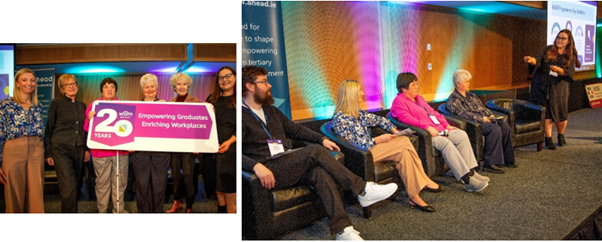
Photo Montage: 1. Deirdre Moore, Ann Heleen, Tina Lowe, Dr Mary Quirke, Pauline Ryder and Caroline McGrotty. 2. Philip Carroll, Deirdre Moore, Tina Lowe, Dr Mary Quirke and Caroline McGrotty.
Their stories illustrated how WAM began as an ambitious idea that through deep commitment from AHEAD and the initial employers became a recognised national model for disability inclusive graduate employment.
Working with employers on their graduate programmes we started looking at things like psychometric testing, group assessments, role-play exercises, and technical tests and asking some important questions:
- How are these methods being used? Are they screening people in, or screening them out?
- What barriers do they create?
- Can we offer alternatives?
- And do we even need some of these methods at all?
Caroline McGrotty, former AHEAD staff
The structure of WAM remains pioneering today:
- Ring-fenced graduate placements exclusively for disabled candidates;
- Paid, mentored, 6-month minimum opportunities;
- Needs Assessments to identify reasonable accommodations;
- Training for mentors, managers, and participants;
- Ongoing support for both graduates and employers.
These design elements have made WAM not just a placement programme, but a catalyst for real cultural change in organisations.
And the outcomes speak volumes. Since 2005:
- 800 graduates with disabilities have completed WAM placements;
- 81% (percent) secured employment after completing their placement;
- 92% (percent) gained confidence working in mainstream environments;
- Hundreds of Irish employers have built their disability-inclusive capacity through WAM.
As we look forward, unemployment is still an issue for people with disabilities, but underemployment is a growing issue for this population. I would pose - have we really moved beyond placement - we need to not just place people in graduate jobs but give them the opportunity to move through employment, up and sideways.
Dr Mary Quirke, former AHEAD staff
Launch of the Widening Inclusion of Disability in Employment (WIDE) Framework
Anna Boda, Programme Manager, Employers for Change, Catherine Murray, Research and Administrative Assistant, AHEAD, and Dara Ryder, CEO, AHEAD introduced the WIDE partnership and launched the WIDE web platform.
WIDE represents a future-focused, practical support system for employers committed to improving their recruitment, retention, and progression of disabled talent. An interactive demo station in the foyer allowed attendees to explore the new platform first-hand.
Investing in inclusion is investing in business itself and has a positive impact in a myriad of ways- recruiting a diverse talent pool, retention, innovation and creating workplaces that reflect society itself.
Jeanne McDonagh, CEO Open Doors Initiative
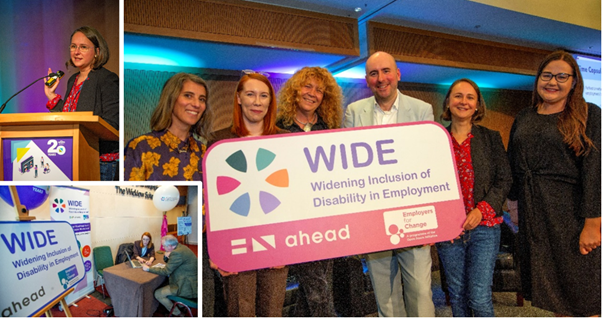
Photo Montage: Anna Boda, Employers for Change. 2. Dr Joanne Banks, Catherine Murray, Jeanne McDonagh, Dara Ryder, Anna Boda and Caroline McGrotty. 3. Catherine Murray.
Panel 1: Inclusive Employment – Past and Present: Reflecting on 20 Years of the WAM Programme
This panel discussion brought together former WAM graduates alongside WAM employers ESB, Allianz and Publicjobs. Together they shared lived experiences and insights exploring graduate challenges in accessing the labour market, discussing inclusive workplace practices, reflecting on WAM’s impact, highlighting ongoing barriers for disabled people and employers, and celebrating examples of inclusive employment.
A flavour of quotes from Panel 1
I was really scared the gap on my CV would go against me, but I went and met the employer and what struck me about them was their attitude. They got me in there and they asked me what I needed, they didn't assume what I needed, they availed of wonderful grants from DSP particularly the workplace adaptation grant......it really gave me the confidence that there were solutions and there are work arounds and I could do it, WAM and the employer gave me my confidence back.
WAM was a crucial launchpad for my career, my first job ever. I found it hard to find work after college, I could not work the typical student jobs in retail or hospitality, those jobs are not accessible for me. I used my volunteer work in my WAM interview.
An enabler has been the attitude of my colleagues, the people around me asking what I need and what can we do to help you and because I had that backing of WAM I had the confidence to ask and not to apologise for needing what I need.
Please look at your systems and understand that not everyone interacts with them particularly the technology in the same way, for example, not everyone uses a mouse, I don't use a mouse. There will be difficulties and frustrations, not intentionally..... there is work to be done around accessibility and universal design, and the more you design it right, the less people you will have saying this is not working for me, and also, you are including everybody.
Reminder of the importance of having an inclusive culture, being flexible and more open to hearing what people are saying. I think issues arise when workplaces are very rigid in their policies and systems.
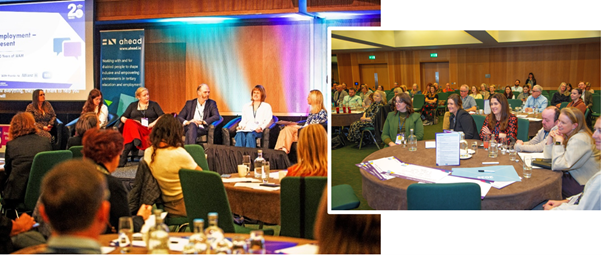
Photo Montage: 1. Natalie Keogh (Allianz), Ali McNabb (former WAM graduate), Aoife Lyons (publicjobs), Tom McMahon (ESB) and Christina McCarthy (former WAM graduate) and moderator Deirdre Moore (AHEAD). 2. Audience
Panel 2: Shifting the Dial on Inclusive Workplaces: How can we close the disability employment gap into the future?
Moderated by Dara Ryder with panellists from Open Doors Initiative, National Disability Authority (NDA), Independent Living Movement Ireland (ILMI), and Ibec shared diverse perspectives on what is needed to accelerate progress.
Their discussion explored:
- persistent structural barriers;
- the need for stronger employer supports;
- cultural shifts required to normalise inclusion;
- opportunities for cross-sector collaboration;
- hopes for workplace equality across the next decade.
A flavour of quotes from Panel 2
Barriers for employers are lack of awareness and education around disability that’s why training and education is so important to meet that gap. There is also a fear among employers of getting things wrong, not having the right language and awareness and education to support people with disabilities and the confidence to hire people with disabilities. There is a low awareness and misconceptions around reasonable accommodations.
Employers doing well in this space are seeking partnerships from orgs who can provide them support and guidance to progress in this area, have expertise to hand and put things into action.
Employers need to realise the lived experience of barriers – we are disabled by systems and structures and they need to be informed by people with lived experience and comply and adhere to legislation.
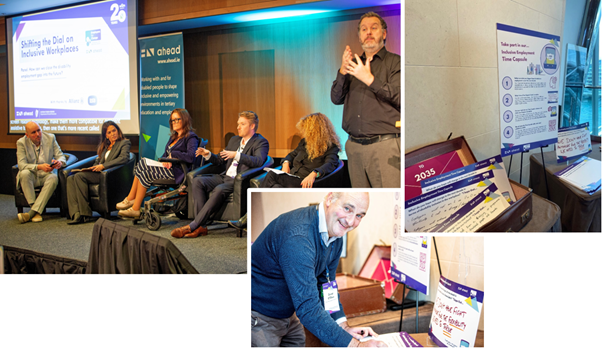
Photo Montage: 1. Dara Ryder (Moderator, AHEAD), Megan O'Sullivan-Sweeney (IBEC), Fiona Weldon (Independent Living Movement Ireland), Robert Murtagh (National Disability Authority) and Jeanne McDonagh (Open Doors Initiative). 2 & 3. Capsule station.
Marking the Moment: WAM Leader Awards
The WAM Leaders Awards recognised the following employers who have shown leadership in inclusive employment through their engagement with WAM over the last year and beyond.
Employers
Abbott, Bank of Ireland, Bord Bia, Central Bank, Citi, Dell, Diageo, EirGrid, Enterprise Mobility, ESB (ESB International and ESB Networks), Guidewire, Green Party, Local Government Management Agency and Local Authorities, Mental Health Commission, Munster Technological University – Kerry, NTMA (National Treasury Management Agency), Optum, Pfizer, Salesforce.
Civil Service Departments
Department of Enterprise; Trade and Employment; Department of the Environment; Climate and Communications; Department of Housing, Local Government and Heritage; Department of Justice, Home Affairs and Migration; Department of Rural and Community Development; Department of Public Expenditure, Infrastructure, Public Service Reform and Digitalisation; Department of Social Protection, Irish Human Rights and Equality Commission, Houses of the Oireachtas; Office of the Ombudsman; National Shared Services Office (NSSO); Publicjobs; Revenue Commissioners.
WAM Leader Testimonials
This programme serves as a valuable opportunity to assess and enhance our onboarding processes while also strengthening disability confidence among our hiring managers, by fostering these inclusive practices we are building a more sustainable and effective talent model.
Bank of America
The talent is awesome, and we need to embrace it.
Bank of Ireland
Overall, the mentoring programme has been a valuable investment in personal and professional development, and I'd highly recommend it to anyone who wants to enhance how they lead people.
Bord Bia
Learnings through participating in WAM have been around needs assessments and reasonable accommodations and the training provided has grown our line managers confidence in disability interviewing and leadership and this learning is also reflected in our job specs and universally applying this to wider recruitment.
Local Government Management Agency
Through the WAM programme we had a high standard of candidates and overall, a positive experience with WAM providing us with practical advice and resources.......our WAM graduate was offered a permanent position, and we look forward to working with WAM again next year.
Mental Health Commission
We have been looking globally to start disability hiring programmes in the US, India and Australia and we couldn't find an equivalent of AHEAD anywhere else. AHEAD is an incredibly special organisation and we are so lucky to have them in Ireland.
Employee Experience and Belonging, Guidewire
Inclusive Employment Time Capsule
Throughout the day AHEAD engaged the audience in the theme of the day by inviting them to reflect on the question:
What do you hope will change in the next decade in terms of disability inclusion in the workplace?
Participants wrote their hopes on the cards and placed them in a Time Capsule suitcase. This will be reopened and displayed by AHEAD in 2035 at an event marking the 30 years of WAM and the 10 years of WIDE.
Getting Involved: The Journey Continues
As WAM celebrates 20 years and WIDE begins its journey, AHEAD is calling on graduates, employers, educators, and supporters to join the movement:
- Disabled graduates seeking employment - Join the WAMWorks Database for job and event alerts! - AHEAD
- Employers interested in offering a WAM Placement? WAM Programme – Employer Info - AHEAD
- Explore the WIDE Framework Welcome to WIDE! - Widening Inclusion of Disability in Employment
- Do you support disabled students and graduates? Tell them about AHEAD’s GetAHEAD and WAM programme and encourage them to join WAMWorks Database for job and event alerts!
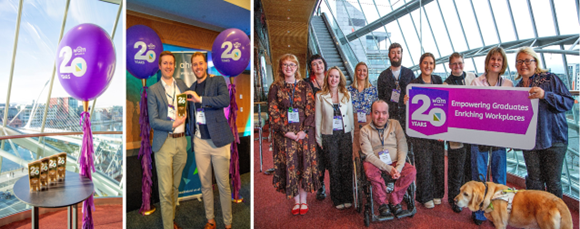
Photo Montage: WAM Leader 20 year award plaques. 2. WAM Leader Award winner Guidewire. 3. WAM team and former WAM graduates.


